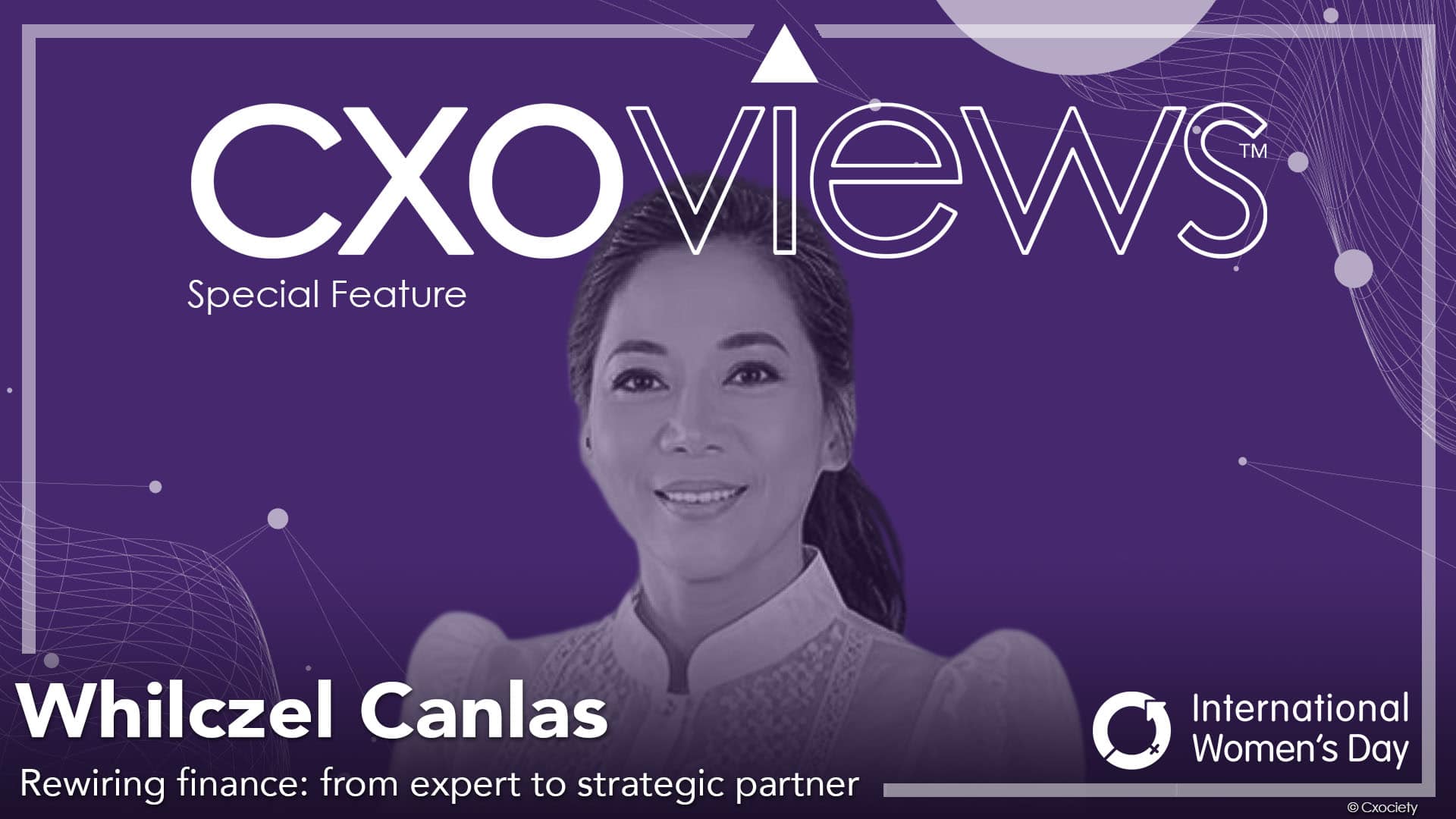
Whilczel Canlas built her career on the bedrock of technical excellence. As a certified public accountant, she is fluent in the language of financial reporting, controls, and compliance. It is a world she understands intimately, and one in which she excels.
Yet the single most critical decision of her over-two-decade journey was not mastering another accounting standard or tightening another control. It was choosing to step beyond the structured boxes of finance and become something far less defined on any org chart: a business partner.
“Leadership is not about being in charge, but it’s about taking care of those in your charge,” Canlas says, quoting Simon Sinek, a mantra that has guided her from the Philippines to senior leadership at ibex.
Whilczel Canlas
“Leadership is not defined by title, age, or authority, and it’s defined by responsibility, service, and the impact we create for others.” Whilczel Canlas
That philosophy became the lens through which she reframed her entire career.
The comfort of the ledger
Early in her career, Canlas was, by her own admission, very comfortable in the world of financial reporting, controls, and compliance. As a CPA, she had those strengths. The rules were clear, the outcomes measurable, and the boundaries well understood. It is a familiar story for finance professionals across Asia, many of whom enter the profession drawn to the certainty of numbers.
But Canlas soon noticed something unsettling. The leaders shaping the future of their organisations were discussing much more than numbers. “They are typically discussing strategies, how to grow big, transformations in people,” she recalls.
The conversations in boardrooms and executive off-sites were about resource allocation, market expansion, and operational leverage—topics that required business fluency, not just bookkeeping.
This tension between technical depth and commercial breadth is one of the defining challenges of modern finance.
According to the 2026 EY Global DNA of the CFO Survey, 60% of CFOs surveyed say finance leaders should define and shape how the business creates value, and 55% agree that finance should accelerate value creation initiatives. Yet only 27% say the business primarily sees finance as a strategic partner in value creation. The gap between ambition and perception remains stubbornly wide.
Joy Olivo, group corporate controller at D.W. Morgan Company, captured this dynamic in an interview with FutureCFO: “Strong controllership creates the foundation, but the real value of finance is when it becomes a strategic business partner—helping leadership interpret the numbers, anticipate risks, and make better decisions for growth.”
The volunteer mindset
where she was the most junior person present, surrounded by executives debating how to maximise resources and steer the company through uncertainty. Rather than shrinking back, she observed. “How do they think? How do they pass a thing?” she remembers. “How can I pitch in as a very new executive during that time?”
Those moments taught her to think beyond finance and see the bigger picture. She began to understand that leadership was not about becoming the smartest person in the room, but about helping the organisation and the people around her succeed. The technical expertise she had spent years building did not disappear; it became the foundation upon which she constructed a broader commercial perspective.
This willingness to operate outside formal responsibilities is precisely what distinguishes finance business partners from traditional accountants. As Grace Liu, COO at Legacy Trust, told FutureCFO: “When finance professionals actively contribute to shaping strategy rather than simply validating outcomes, the impact on the organisation is significant.”
What business partnering actually means
For Canlas, the concept of finance as a business partner is neither abstract nor soft. It is operational. “Most of the time, if you’re an accountant, you share the ownership,” she explains. “It’s not about just being so technical about the compliance, booking all the transactions of the company, but you share some. It’s joint decision-making.”
She describes it as a dynamic between brainstorming across functions: sales, finance, logistics, supply chain. Everyone is a business partner. “It’s like a moving machine,” she says. The finance professional must be willing to go beyond structured boxes, consider options, and operate the business alongside other functions. Sometimes, she notes, that means being “relaxed on your policy” when the strategic context demands it.
This definition aligns with what Hongrui Mo, CFO for Asia at MET Asia, shared with FutureCFO in 2024. “I don’t know why, but it always seems that the finance function is seen as a cost centre. I want to challenge that notion. In fact, (as a CFO) I business partner a lot with other departments, including technical, sales, etc. I do a lot of outreach.”
The data behind the shift
Seismic shifts across the finance profession mirror Canlas’s personal evolution. The EY survey reveals that CFOs surveyed report 47% of their capacity is still devoted to operational tasks such as regulation, reporting, internal controls, and core finance processes. This operational burden is precisely what Canlas had to escape.
Gartner predicts that by 2028, 70% of finance functions will use AI analysis of connected device data for real-time decision-making on operational costs and cash flow management. The automation of transactional work is not a distant future; it is an urgent present.
Deloitte’s Finance Trends 2026 survey found that strategy-influencing finance leaders are already delivering clear, measurable value from AI investments at more than twice the rate of those in strategy-supporting roles—37% versus 17%.
Nikhil Parambath, a voice on FutureCFO’s PodChats, put it succinctly: “Every single technology… was one step towards [making finance] a strategic business partner. Agentic AI might actually be the single biggest change that we’ve seen to make this a reality.”
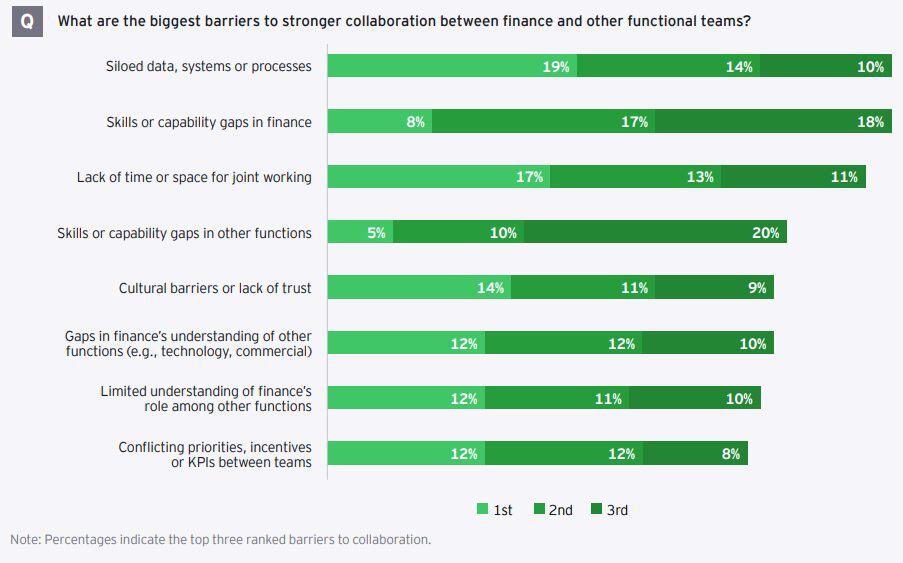
Source: EY Global DNA of the CFO Survey, 2026
Yet technology alone will not close the gap. The EY survey found that despite the importance of collaboration, just 29% of CFOs describe the culture of collaboration between finance and other functions as “open and enabling.” The barrier is cultural as much as it is technical.
How to make the leap
Canlas’s advice to those seeking to make the same transition is both simple and demanding. “Be curious beyond your job description,” she says. “Some of the most valuable experiences in my career came from projects that were outside my formal responsibilities.”
She asked questions, volunteered for strategic initiatives, participated in transformation projects, and learned how decisions are made at the executive level.
She also learned to communicate her value. Early on, she believed hard work alone would speak for itself.
“I thought that hard work was my best support to build my career,” she admits. “But over time, I realised that leaders must also understand your aspirations and the value you bring.” Coming from an Asian culture, she appreciates humility but learned that “humility should never become invisibility.”
For aspiring leaders, she offers a clear prescription. Build deep technical expertise early—it remains the foundation of credibility and strong governance. But continuously expand your commercial perspective. Understand the business model, customer needs, operations, technology, and strategy. Learn how decisions are made and how value is created.
“The future belongs to leaders who can connect the numbers to purpose,” she says. “So, it’s not only just numbers, but the purpose.”
The new measure of success
Leadership is measured by the people you develop
Canlas’s story is ultimately one of redefinition. Success, she learned, is not measured by the title on a business card. “It is measured by the people you develop, the opportunities you create, and the lives you positively influence.”
That philosophy transformed how she leads her finance team at ibex, where she intentionally provides stretch assignments, visibility, and mentorship to help others recognise their potential before they fully see it themselves.
The finance function is at an inflexion point. The EY survey notes that 60% of finance leaders acknowledge the operational burden of the traditional reporting role makes it difficult to focus on strategic priorities. The question is no longer whether finance should evolve, but whether individual finance professionals are willing to evolve with it.
Canlas made her choice more than two decades ago. She chose to see finance not as a department that records history, but as a discipline that helps write the future.
“What I learned along the way is that leadership is not a destination; it is a choice. A choice to step forward when others hesitate. A choice to persevere when challenges arise. A choice to lift others as you climb.” Whilczel Canlas
“Don’t just report the story,” she says. “Help write the next chapter. Your ideas matter. Your voice matters. Your contributions matter.”
She acknowledged that setbacks will be there as part of the journey, and that there will be moments of doubt. “There will be days when progress feels slow. Keep going, ” she urged. She believed persistence and determination will carry you farther than talent alone.
She also believes that purpose will sustain you when ambition alone cannot. “My hope for the next generation is that they do not spend their careers waiting to be chosen,” she concluded.
For the next generation of finance leaders across Asia, that is both an invitation and a challenge.