






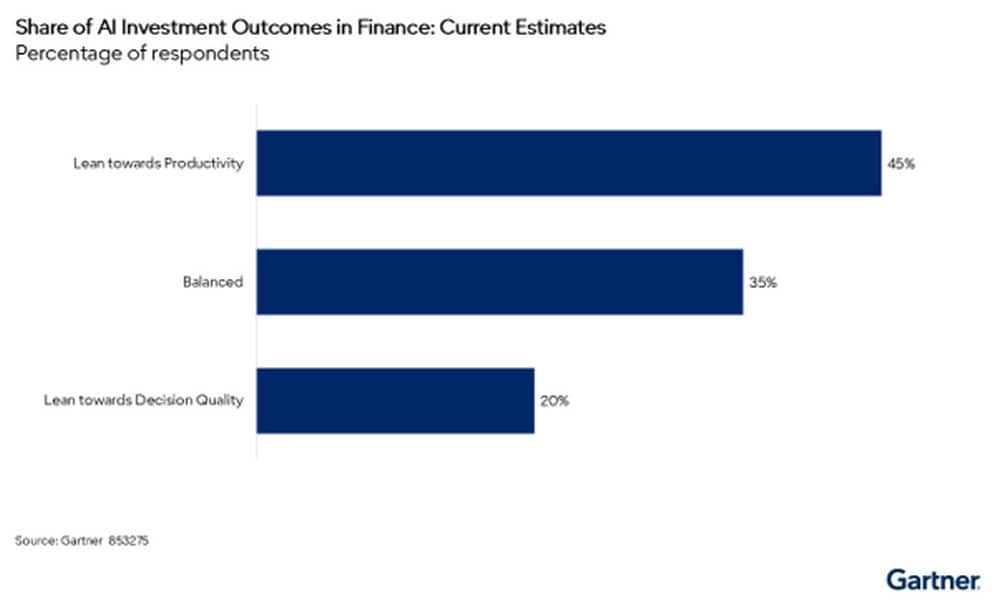
Finance leaders have made impressive progress with artificial intelligence, but they have done so by playing it safe. According to a Gartner survey of 204 finance leaders conducted in March 2026, 45% of finance AI investments focus on productivity, while only 20% target decision quality. The imbalance is understandable, but it carries a strategic cost.

Nick Duffy, senior director analyst at Gartner, is blunt about the root cause. “Cost optimisation is going to be important to every organisation in every part of the world forever,” he says. “It’s not a problem that’s going to go away.”
Faced with that permanent pressure, CFOs have gravitated towards investments with clear, measurable returns. “CFOs have made very safe bets,” Duffy explains. “They’ve made it on things that they can very clearly see ROI, which comes back to personal productivity.”
There is nothing wrong with that as a starting point. Automating a reconciliation process or accelerating a reporting cycle delivers quick, demonstrable value. But Duffy warns that this is precisely where the danger lies. “If we just stay focused on those things, that’s where this gap between return on investment is going to grow.”
The problem is one of ceilings. Once a task becomes faster or lighter touch, the benefit plateaus unless that efficiency changes a broader business decision. Productivity gains, in other words, do not compound into enterprise value on their own.
The perception gap with boards
This imbalance widens the disconnect between finance leaders and their boards. CFOs report progress on AI adoption; boards see limited strategic impact. Gartner’s research found that functions investing in “Upend” AI initiatives — those creating new value propositions, products or markets — were more than twice as likely to report high realised value.
Boards, Duffy notes, are becoming more educated and their expectations are skyrocketing. “They’re looking to CFOs and all their functional leaders to increase reporting around ROI as the amount of investment grows.”
Rather than treating that scrutiny as a threat, Duffy frames it as an opportunity. “For CFOs, this is an opportunity to challenge the board and to treat this scrutiny as permission to go up to some of the bigger, bolder bets.”
His advice is to reframe the conversation entirely. When a board asks why AI tools in finance aren’t producing more value, CFOs should broaden the question across the whole organisation. Instead of defending a narrow portfolio of low-hanging fruit, they can explain how the portfolio is currently structured and make the case for bigger investment.
This is becoming more urgent as scrutiny intensifies. Duffy draws a direct parallel to cloud spending, which the board has already examined. “Absolutely, that’s exactly what we’re saying with a lot of commentary around token spend,” he says. “We’re going to see more scrutiny moving forward.”
Measuring what matters
If CFOs are to rebalance towards enterprise value, they need metrics that capture it. Duffy acknowledges the challenge: CFOs are “big on metrics,” which is precisely why they gravitate towards productivity. Saving a hundred hours through automation is black and white. Decision quality is harder to quantify.
But it is not impossible. Duffy identifies three levers that finance can tie AI impact to: revenue outcomes, cost reduction and cash flow. From there, CFOs can design concrete measures.
“Some examples that I’ve seen might be the decrease in revenue leakage through bad decisions or through errors,” he says. “Another example is on productivity and its relationship to revenue growth — the increase in output per SGA function employee.”
One of the simplest and most powerful is sales conversion rate. “If we’re helping the business, the sales team, the marketing team go up to the right customers, get our pricing right, managing the sales pipeline, then we would expect to see an increase in the conversion rate of our sales.”
Cash flow offers another dimension: reduced working capital days, or a more efficient collections process, expressed as a percentage improvement.
The critical shift, Duffy argues, is broadening how finance thinks about ROI itself. “Finance thinks about ROI in a very simplistic way — we spend X amount on tokens and training, and we’ve been able to displace X hours or people. We need to broaden that.”
He recommends starting with a definition of value. “Are we prioritising top-line revenue growth? Is it about cash flows, or both? And then work backwards. What’s the biggest opportunity for AI within those kinds of realms?”
Building trust in AI-driven decisions
Presenting AI-driven decision-making as essential — particularly in a region as diverse and heavily regulated as Southeast Asia — requires overcoming a trust deficit. Duffy identifies several lenses through which that scepticism operates, beginning with trust in the numbers themselves.
“I’m seeing some degree of fully automated decisions for the operational decisions — not major strategic decisions,” he says. “The more strategic stuff, that’s where this trust and scepticism sits.”
CFOs must address this on three fronts. First, they need to bring their teams along. “They need to make sure that their team, the people they control, are on board with building AI into this decision-making process.” That means being transparent about AI’s role in the workflow, especially as staff continue to worry about job security. The message must be that AI enhances the decision-making engine, not simply automates processes.
Second, CFOs must show that it works. Duffy has seen organisations run a dual decision-making process, comparing traditional manual analysis with AI output to learn where AI adds value and where it does not.
Third, they should identify activities where AI is essential and embed it there. Duffy is cautious about overreach: “We need to stay away from the big financial decisions at the moment.” Instead, he advocates using AI in agreed areas where it has been proven to work. “It’s almost building trust in that going forward.”
The portfolio approach to growth
For CFOs looking to unlock growth — particularly as Asia-Pacific capitalises on its digital economy and capital markets show renewed vigour — Duffy returns repeatedly to the portfolio metaphor. He offers a simple analogy: a hundred AI pennies to spend across finance.
“We don’t want to be spending 99 of them in this kind of lower productivity,” he says. “If it’s a 10-90 split where 90% of our pennies are productivity, easy GenAI producing things, versus having more of a 50-50 split — that’s how we’re going to start to win.”
Every organisation’s balance will differ, just as every investor’s portfolio does. “You don’t have it all in gold, you don’t have it all in tech. You want to have a bit more of a balanced portfolio. That’s what’s lacking at the moment.”
Beyond portfolio balance, AI can also accelerate decision-making—something Duffy says every CFO he’s spoken to in the last decade has wanted. “We lose market share because we think about things too much.” Whether it is the regular management reporting pack that isolates operational issues, or bigger, bolder growth bets around new markets, pricing and products, acting faster is a competitive weapon.
Reshaping the talent pyramid
None of this is achievable without the right people, and here Duffy describes a structural shift. The traditional bottom-heavy finance pyramid, with large numbers of entry-level staff, is giving way to a diamond shape. Entry-level roles will shrink; a thicker, more highly skilled middle layer will emerge.
“This middle layer is going to be different,” he says. “These are going to be more highly skilled people that may not have a team, or at least a very big team, but they’re responsible for really sizable outcomes.”
The CFOs making the most progress are highly specific about the skills and roles they need, defining future capabilities and helping their teams bridge the gap transparently. Training varies — much of it on the job, supplemented by vendor tutorials and formal qualifications.
On retention, Duffy is clear that commitment beats tokenism. “One of the biggest retention tools is an employee seeing their leaders’ commitment to what AI is going to do for their firm.” Clarity matters too: what AI will do, what will remain human, and the anticipated timelines.
“The employees that we want, they want to work for firms that take this seriously, that have this capability and that are investing in it,” he says. “That goes above pay and flexible work strategies.”
The rebalancing imperative
Asked for his single piece of advice to CFOs seeking to meet board expectations, Duffy returns to the portfolio. “Investments going forward need to be much more focused on finance’s ability to drive awesome decision quality.”
That means slowly rebalancing away from productivity and time-saving wins toward bigger, bolder tools—and having that conversation with the board. But he adds one final caution: “Make sure you bring your team along on the journey. Don’t leave them behind.”
For CFOs in Southeast Asia and Hong Kong, the message is unmistakable. Productivity gains are a foundation, not a destination. The organisations that rebalance toward decision quality, growth, and enterprise value—while carrying their people with them—will be the ones whose AI investments genuinely meet the board’s expectations.