





For finance leaders, the conversation around artificial intelligence is moving beyond whether AI should be adopted to a more fundamental question: what business value is it actually delivering?
As organisations roll out AI across forecasting, reporting, financial planning and analysis, and other finance processes, CFOs are increasingly tasked with ensuring that these investments translate into measurable improvements rather than simply adding another layer of technology to the enterprise.
The next phase of AI adoption will therefore require finance leaders to look beyond implementation milestones. From establishing the right data and governance foundations to identifying high-value use cases and measuring returns over time, CFOs have a critical role in turning AI from an experimental capability into an embedded business tool.
The challenge is not simply putting AI to work in Finance, but building an approach that can scale, adapt to changing business needs and deliver lasting gains in productivity, decision-making and financial performance.
As AI moves from experimentation into scaled deployment, the CFO’s role increasingly shifts from assessing the cost of individual projects to evaluating their broader contribution to enterprise performance.
This means looking beyond immediate cost savings to consider whether AI is improving productivity, accelerating decision-making, strengthening forecasting accuracy, increasing revenue opportunities, or enabling the business to operate more effectively at scale.
For finance leaders, the challenge is to establish a framework that captures both the near-term financial return and the longer-term strategic value of AI investments.
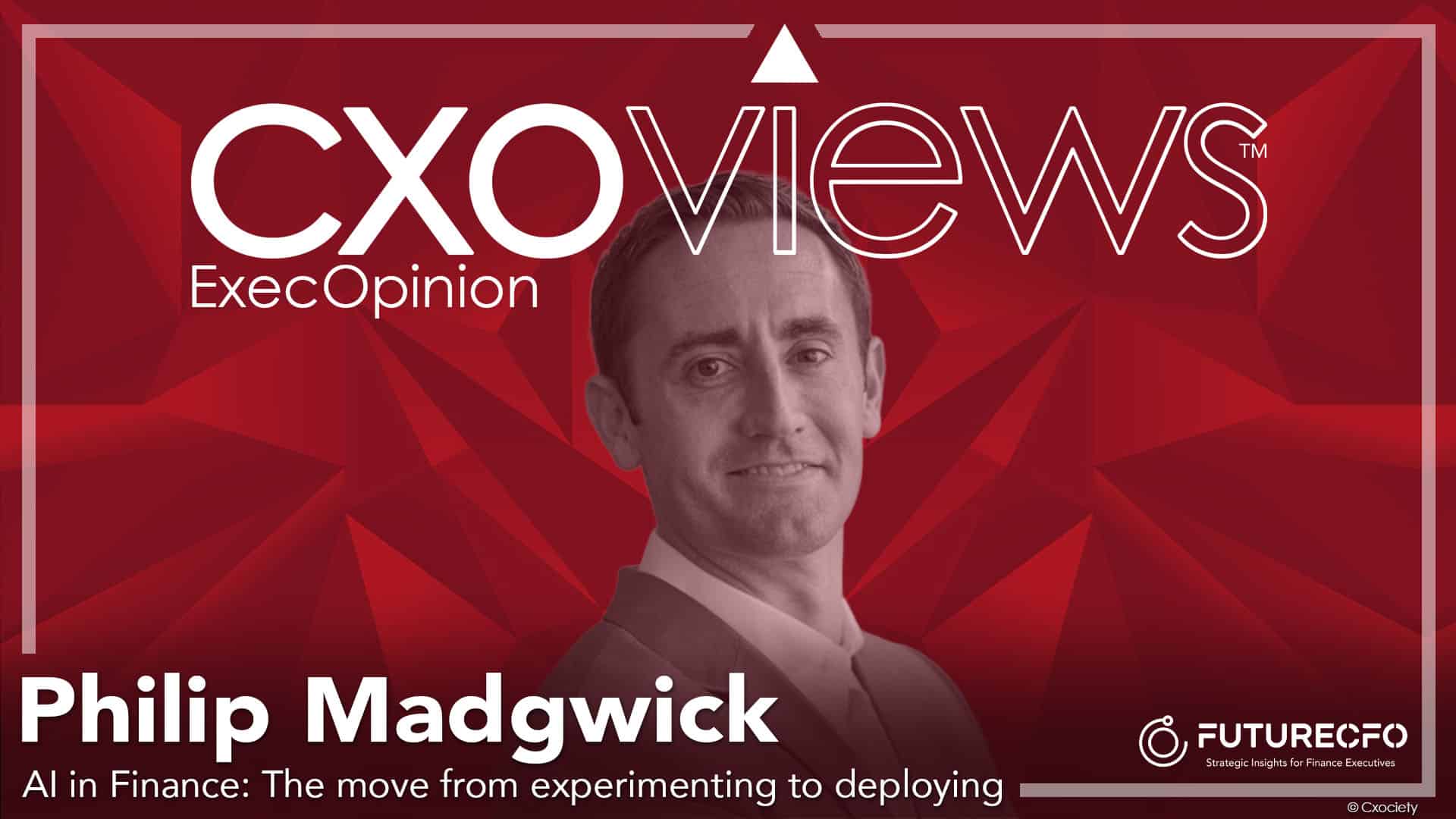
Philip Madgwick, Regional Vice President, Asia at Alteryx, believes that as enterprises move from experimenting with AI to deploying it at scale, the way CFOs evaluate AI investments needs to evolve beyond a traditional technology business case.
“The question is no longer simply whether an AI initiative can reduce costs, but whether it can create measurable, sustainable enterprise value,” Madgwick notes.
Looking at indicators
Madgwick says cost savings and productivity remain important, but finance leaders should also be looking at indicators such as decision-making speed, forecasting accuracy, risk reduction, quality of outputs and the ability to scale a process without proportionally increasing headcount or operating costs.
“These measures help capture value that may not appear immediately as a direct reduction in expenditure,” he opines. “CFOs should also pay close attention to the reliability of the underlying AI workflow. An initiative that generates impressive productivity gains in a controlled pilot may not deliver the same value when exposed to the complexity of enterprise data, governance requirements and real-world decision-making.”
He thinks the financial case therefore needs to account for the quality of the data, the governance required to operate the system responsibly, and the business logic underpinning the decisions it supports.
“For example, Alteryx’s 2026 State of the Data Analyst: The Rise of Business Logic study, which surveyed 1,400 data analysts and IT leaders globally, including 175 respondents in Singapore, found that Singapore data analysts spend an average of five hours a week preparing and cleaning data, and a further three hours correcting and validating AI-generated outputs.”
He says this highlights how the value of AI can be eroded when employees have to compensate for unreliable inputs or outputs.
“This is where the business logic gap becomes particularly important. Organisations can invest heavily in models and infrastructure, but if the rules, risk thresholds, and operational context that define a good business decision are not embedded into the workflow, the resulting outputs may be technically impressive but operationally unreliable.”
For CFOs, Madgwick says the ultimate question should therefore be: does this AI investment improve the organisation’s ability to make better, faster and more reliable decisions in a way that can be measured and sustained? That is a much stronger basis for evaluating enterprise value than cost savings alone.
Identifying the distinction
AI investments can involve significant upfront spending on technology, data, talent and infrastructure. That is why CFOs need to distinguish between AI initiatives that are likely to generate measurable enterprise value and those that risk becoming expensive experimentation.
Madgwick believes the distinction comes down to whether the organisation can demonstrate a clear path from the initial use case to a meaningful business outcome.
“The starting point should be a specific business problem rather than the technology itself,” he notes. “CFOs should ask: what business outcome are we trying to improve, what is the baseline today, and what would success look like? This could be reducing the time required for a process, improving forecasting accuracy, increasing revenue or reducing operational risk.”
Without a defined outcome and baseline, he says it becomes difficult to establish whether an AI investment is actually delivering value.
He adds that CFOs should also assess whether the initiative is capable of moving beyond a controlled pilot. A successful demonstration in a limited environment does not necessarily mean an AI workflow is ready for enterprise deployment.
“The organisation needs to consider whether the workflow can produce reliable results consistently, validate those results, and ensure the processes around it are mature enough to support wider adoption.”
He explains that this is where the VURA principles (Visible, Understandable, Repeatable and Auditable) serve as a useful test.
“An AI workflow should make it possible to understand where an output came from, validate the logic behind it, reproduce results consistently, and establish a clear trail of accountability.”
Ultimately, Madgwick says CFOs should not be asking simply whether an AI initiative works. They should be asking whether it can deliver a defined business outcome reliably, repeatedly and at a scale that justifies the investment. That distinction is critical to ensuring AI spending creates enterprise value rather than simply expanding experimentation.
Quantifying AI’s impact
Productivity gains from AI can be difficult to translate into financial outcomes. For this matter, finance leaders should be able to quantify the impact of AI-driven automation and analytics on areas such as employee productivity, operating costs, forecasting accuracy and decision-making speed.
For Madgwick, CFOs need to first establish a clear baseline before AI is introduced, because this is how one can measure the change against that baseline.
“The important distinction for finance leaders is between activity that has been automated and value that has actually been realised.”
For employee productivity, he says saving employees several hours a week does not automatically translate into lower costs. Finance leaders should look at what happens to that recovered capacity.
He asks, “can the organisation handle more work without increasing headcount? Can employees spend more time on higher-value activities? Or does the time simply get absorbed elsewhere? These outcomes should be reflected in the financial assessment.”
Moreover, Madgwick believes the same principle applies to analytics and decision-making. Rather than measuring only how quickly AI can produce a forecast or recommendation, organisations should track improvements in forecasting accuracy, reductions in error rates, financial impact, and the speed of decision-making.
“A faster decision has value when it enables the business to respond more quickly, while a more accurate forecast can improve planning, resource allocation and financial performance.”
Finance leaders should also account for the full cost of delivering these gains, including the ongoing cost of maintaining data, validating outputs and managing the workflows. He notes that this helps ensure that the organisation is measuring the net value created rather than simply the gross productivity improvement.
“Ultimately, the objective should be to connect AI-driven productivity gains to measurable changes in cost, capacity, revenue, risk or decision quality. The strongest AI business cases are therefore not built around how much work AI can automate, but around what the organisation is able to do better, faster or more efficiently as a result.”
The CFO’s role
In terms of the role the CFO should play alongside the CIO and other technology leaders in prioritising AI investments across the enterprise, Madgwick thinks the CFO should play an active role in the technological advancement’s prioritisation, but not by becoming the technology decision-maker.
“The CFO’s role is to ensure that AI investment is tied to business priorities, supported by measurable value, and grounded in clear understanding of the resources and risks required to deliver it,” he says.
This, for Madgwick, requires close collaboration with the CIO and other technology leaders. “CIOs bring expertise in infrastructure, security and implementation, while business leaders understand the operational problems AI is intended to solve.”
He adds that finance brings a complementary perspective on how the investment supports the organisation’s strategic priorities and on the expected value to justify the resources being committed.
“Importantly, AI prioritisation should not happen exclusively within technology functions. The people closest to day-to-day operations often have the clearest understanding of where AI can create value, as well as the rules and context that need to be reflected in AI-driven decisions.

“Alteryx’s research found that 66% of Singapore respondents agree that AI and agentic systems are most productive when the underlying logic is owned and managed at the business level.”
Madgwick thinks this points to a broader shift in how organisations should approach AI investment. Rather than asking which technologies they should adopt, CFOs, CIOs and business leaders should collectively ask where AI can make the greatest contribution to strategic objectives and whether the organisation is equipped to realise that value.
“Finance can play an important role in creating that discipline by establishing consistent criteria for evaluating initiatives, requiring clear business outcomes and reviewing whether investments continue to deliver against those outcomes over time.”
For him, the objective is not to slow AI adoption, but to ensure that capital and organisational capacity are directed towards the use cases where AI can create the greatest and most sustainable business value.
Looking ahead
In the question of what will separate enterprises that successfully turn AI investment into sustained financial value from those that struggle to move beyond pilots, Madgwick says it will be those that build the organisational foundations to scale it responsibly.
He believes CFOs should therefore think about AI readiness as more than having the right technology in place. They should ask whether the organisation has the data, governance, ownership and measurement frameworks required to sustain AI once it moves into production.
“Our research highlights why this matters: 46% of AI and analytics projects in Singapore that fail to meet their objectives are attributed primarily to data-related issues, while a further 46% of respondents identify unclear ownership and accountability for AI-driven decisions as a barrier to turning AI-generated insights into action.”
Ultimately, the Alteryx executive expects the organisations that move beyond pilots will not necessarily be those with the most sophisticated models. They will be those that can connect AI to trusted data, sound business logic and clear accountability, and demonstrate that the resulting outcomes are reliable, measurable and sustainable over time.