





According to IDC robotic process automation (RPA) and intelligent automation (IA) will play a pivotal role in addressing business problems and goals in 2020.
The analyst goes further to predicts that a new focus will be apparent among FSIs to derive unprecedented value for the business, customers, and employees through a combination of automation and AI, by improving operational efficiencies, reducing costs, driving business growth, enhancing customer and employee engagement, and delivering contextual customer experience.
By 2022, IDC Financial Insights expects that 75% of Tier-1 Asia/Pacific banks and insurance companies (businesses with over US$10 billion in asset size) will deploy intelligent automation solutions at scale for increased automation, intelligent decision making, and improved operational efficiencies to achieve exceptional business value and deliver a more real-time and contextual customer experience.
IDC also predicts that intelligent automation solutions will significantly accelerate how cognitive/AI technologies are consumed within financial services.
“RPA and intelligent automation will play a pivotal role in addressing business problems and goals in 2020. A new focus will be apparent among financial services institutions to derive unprecedented value for the business, customers, and employees through a combination of automation and AI, thus improving operational efficiencies, reducing costs, driving business growth, enhancing customer and employee engagement, and delivering contextual customer experience,” says Sneha Kapoor, Research Manager at IDC Financial Insights Asia/Pacific.
Bold predictions that run in contrary to the current state of AI/automation adoption among financial institutions in the region, according to a recent survey by the CFA Institute.
But technology alone is not going to cut it, neither is skills alone. In the Investment Professional of the Future report, respondents to the Industry Leader Survey were asked to rank in importance the skills needed by the profession.
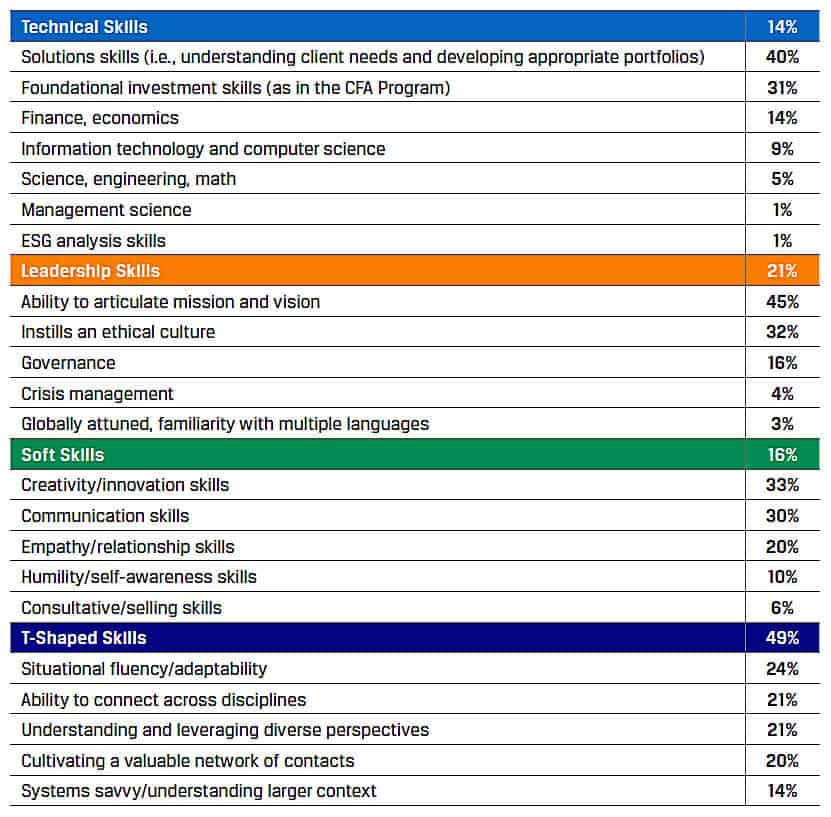
Source: Industry Leader Survey, CFA Institute 2019

Larry Cao, senior director for industry research with the CFA Institute, acknowledged that in more developed markets awareness of what artificial intelligence, automation and big data are high, and that financial institutions are exploring various options with regards to use of these technologies.
At the same time, he confirmed that in less developed markets, people are very excited about the potential of these technologies but are less familiar with the details.
In the report, AI Pioneers in Investment Management, the CFA Institute noted that overall adoption of the technologies by industry players remain slow despite management enthusiasm, pointing to a clear disconnect between AI plans and use.
Other key findings
- The machine is only as intelligent as the data it learns from.
- ML techniques are best suited to systematic strategies.
- Unstructured and alternative data are typically used more by discretionary managers.
- Niche and sector-specific data are more relevant for a fundamental analyst or portfolio manager focused on searching for alpha rather than a systematic manager.
- The effective use of such sector-specific data may prove an important opportunity for the besieged active management sector.
In this exclusive interview with FutureCFO, Cao elaborates on the challenges that financial institutions will face and attribute part of this challenge to the usual lack of collaboration between the business function and the information technology teams.
He pushed aside the prevailing misconception that AI will displace jobs and reckoned that it is the combination of Artificial Intelligence and Human Intelligence that will be the basis of future work within the financial services industry.
What is required, therefore, is the acquisition and constant improvement of skills to remain effective in the use of technologies like AI and big data.
He also suggested the creation of T-shaped functions with these investment firms. CFA Institute refers to these as innovation functions where operations and IT work together to explore what the technology can deliver to the business.
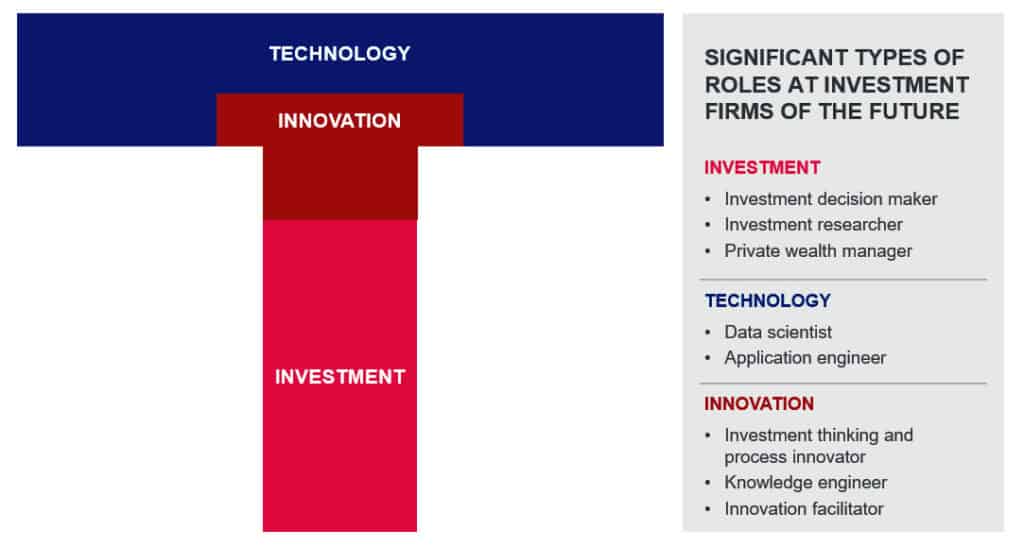
Investment professionals must be conversant with the new technologies,” he added.
“Successful investment professionals in the future will be able to work efficiently with data scientists on their teams – while not needing to become data scientists themselves. It takes time to develop and adopt AI and big data applications, which makes it a compelling reason for all aspiring investment firms to act today,” concluded Cao.