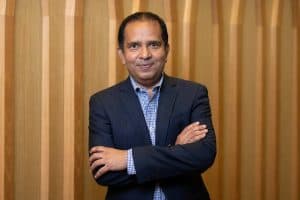






Editor’s note: In today’s A Day in the Life, Jérôme Le Louer (pictured), fractional and interim CFO, managing partner at SmeCFO Asia; and Head of Finance at Tomorrowland Thailand, shares with FutureCFO audiences how his typical day looks like and how Judo influenced the way he approaches leadership, decision-making and life.
FutureCFO: What does a typical day look like for you, and how does managing multiple finance functions at once differ from being the CFO of a single organisation?
Jérôme Le Louer (JLL): My day starts at six. I take my kids to school, then train for an hour of CrossFit. That hour is not a luxury. Good for the body and the mind: a difficult day after an exhausting WOD (workout of the day) feels easy. It builds resilience, focus, strength and discipline.
Back at my desk, I keep the first block for whatever needs full concentration: a monthly close to review, a board pack, a financing decision for one of my companies. From mid morning it becomes a sequence of conversations, owners and CEOs first, then the finance teams executing behind them.
I typically carry five to six active engagements at a time across Thailand, Singapore, Hong Kong and Vietnam, so the calendar is the real management tool. And since the management teams I work with sit in Europe, Asia and the US, there is no typical day in the strict sense.
Depending on the engagement, my hours can stretch from early morning to late evening, although most counterparts are considerate of Thailand time.
The biggest difference with a single-company CFO role is the leverage. A full-time CFO can rely on presence: he is in the building, he hears things, he can course-correct daily. I cannot. Everything I do has to survive my absence.
Priorities have to be explicit, processes documented, and the local team able to run the machine without me. I work in tandem with a financial controller who owns data quality and systems, which frees my time for the conversations that actually move a business: strategy, cash, pricing, people.
Every day on site has to have a clear impact, especially when the client is in Chiang Mai, Phuket or Indonesia. The conclusion I have drawn is simple: because I cannot be there constantly, my real job is to build a lean organisation where things just work with minimal supervision. If the finance function only performs when I am in the room, I have failed.
FutureCFO: What are the common challenges or priorities you see coming up across organisations today, and what tends to separate finance functions that are able to respond effectively from those that struggle to keep pace?
JLL: Most of my clients operate without a finance leader, so I see at close range what that costs over time. The common belief is that a good accountant is enough. It is, until the company grows.
Then the job changes into something else entirely: building and managing a team, shaping strategy, challenging the business on its numbers.
None of that is an accounting skill. And when nobody owns those things, the same operational bottlenecks appear, whatever the country or the industry.
Late and unreliable numbers is the most common one. When management accounts arrive four to six weeks after month end, or never, every decision is made on memory rather than data, and everything downstream suffers, from pricing to hiring.
System transitions are another: companies invest in a new ERP or accounting platform, delegate the migration to people who have never done one, and finance loses a year. Cash visibility, always. I see lots of companies that are profitable on paper start to worry when the bank balance is drying up, without really understanding why, until you dig into the assumed profitability or the growing net working capital.
Nobody saw it coming, the company is profitable and growing, right? And talent.
Strong accountants are available, but people who can translate numbers into decisions are rare.
There is a persistent structural gap between the accounting function that books the numbers and the top management that needs to understand what they mean.
I have been fortunate to build my practice by filling this exact void. Beyond educational gaps, the root of this issue in Asia is twofold.
First, there is a cultural hesitation to challenge the numbers, to dig for issues when everything looks ‘great’, or to contradict a more senior colleague.
Second, there is often a literal communication barrier. You frequently have a local accounting team speaking primarily Thai and limited English, reporting to management sitting in Paris or London. Who is going to manage that cultural and linguistic gap so the business can actually move forward?
What separates the finance functions that cope from those that struggle is not budget or headcount, and it is usually not technology either. It is discipline in the basics and clarity of ownership.
The teams that perform close their books on a fixed date every month, reconcile without being asked, and know exactly who owns each process. That reliability is what earns finance a seat in commercial decisions. The ones that struggle treat finance as compliance and reporting, produce numbers nobody reads, and then wonder why they are excluded from the conversations that matter.
Automation and AI will widen this gap, because they reward teams whose processes are already clean.
FutureCFO: Looking back at your career, was there a particular experience, transition or leadership challenge that shaped your decision to build a fractional and interim CFO practice?
JLL: In a way, I have always done this in some shape or form. I love finance because I love what sits behind the numbers, not necessarily the numbers themselves but what they mean.
That curiosity took me from a corporate CFO track for the first ten years of my career to ten years of entrepreneurship, building Wishbeer in food and beverage and Plizz in accounting, and now to a logical mix of the two (I mean finance and entrepreneurship, not beer and accounting 🙂).
The practice itself is actually ten years old. Even while running my own company or holding a stable CFO seat, I always took projects on the side: due diligence for large startups, financial health checks, or simply fractional CFO work, sometimes one-off, sometimes long term.
Not necessarily for the money. Mostly for the interest of understanding a new business.
The accounting business is what showed me the market. Through it I saw hundreds of small and medium companies from the inside, and the same picture kept repeating: good businesses, run by capable founders, flying blind financially.
They could not justify a full-time CFO, so they had bookkeeping but no finance leadership. Nobody was watching cash, structuring the banking relationships, or preparing the company for the growth it was actually experiencing.
That planted the idea that finance leadership could be delivered in fractions, matched to what a company needs rather than to a headcount convention.
The corporate track gave me the other half. My last full-time role was regional CFO for a global logistics group, fourteen countries in Asia Pacific, seventy-two finance professionals, twelve offices in Mainland China.
I built the role from scratch. Nobody was sitting in Asia looking after the Asia numbers, and nothing structured came from headquarters to hand me an approach.
The finance function was very decentralised, so I built everything from the ground up, working with group functions and management: a regional reporting framework, a strong team of finance managers in every country, an ERP rollout across the region, core operations centralised into a shared services centre, openings in new markets, and several end-to-end M&A cycles, from due diligence through post-merger integration, including an acquisition in Hong Kong.
The scope was massive, and I thrived in it. It was the closest corporate life gets to entrepreneurship. When that chapter closed in 2025, the natural move was another single seat.
I chose instead to go all-in on the fractional and interim practice, because the most useful thing I could do was carry that discipline into companies that would otherwise never access it. Corporate rigour, applied with an SME’s pragmatism and speed. That is still the approach today.
FutureCFO: How has working across such varied environments changed the way you think about the role of the CFO, and what do you believe finance leaders can learn from operating outside the traditional single-company CFO model?
JLL: Across all these environments I keep coming back to the same conclusion: a CFO can only really do the job when three things are in place, a team, a system, and processes.
That is where most of my work actually happens. Rebuilding an accounting team, running an ERP migration or repairing a failed one, setting up processes so that everyone knows exactly what they own. The rest follows from those pillars, whether it is due diligence or helping founders prepare a fundraise.
I also see the business through an entrepreneur’s eye, because I have been one, and in some ways I still am. For over ten years I was the Chief of Everything, trying to build a company as CEO, COO, CMO and CTO all at once.
When you are building a startup, you do it all. I guess that is what I bring to owners and CEOs today: I can talk to them as a peer who has lived it, and that builds trust and mutual understanding faster than any credential. I know what they are going through, and I can help them not only on finance but on the non-finance topics too.
Working across a logistics group one week, a property business the next, and the Thai entity of an international festival after that also changes your definition of the job.
Very little of what a CFO does is industry-specific. Revenue models differ, and you must respect those differences, but cash, controls, working capital, tax and the quality of information are universal.
Once you have seen the same problem in four industries, you stop treating it as a mystery and start treating it as a pattern with a known set of solutions.
You also learn to diagnose fast. When your engagement is measured in days per month, you cannot spend a quarter forming an opinion; you learn to find the three numbers that describe any business and to ask the questions that expose where value is created and where it leaks.
And you learn humility. Every business, including a festival, has an operational logic that the founders understand better than you ever will.
The CFO’s job is to translate that logic into financial terms the banks, the auditors and the shareholders can act on, not to impose a template.
Finance leaders in traditional seats can borrow from this: scope your role in outcomes rather than presence, study business models outside your industry, and ask yourself what you would fix first if you had only two days a month.
FutureCFO: Is there anything outside of work, whether travel, a book, a personal experience, sport or another pursuit, that has influenced how you approach leadership, decision-making or life as a CFO? What has it taught you?
JLL: Judo. I have competed for most of my life and I still fight internationally in the veterans category, in the under 90 kg division.
Last season I competed at the Japan Veterans International Championships in Tokyo, and I have fought twice at the World Veterans Championships, in Poland and Abu Dhabi.
What I love about it is the chance to keep fighting at a relatively high level against people my own age. I am obviously going for the win, but it is also humbling to be defeated by a stronger opponent.
Judo is about getting thrown, falling, and standing up again. A life lesson.
Judo taught me preparation. A fight lasts a few minutes, but it is decided by months of training, weight management and study of your opponent.
Board meetings are the same: the outcome is settled long before the meeting starts. It also taught me how to lose in public. In judo you lose often, visibly, with a referee confirming it. You bow, you analyse what happened, and you come back.
That relationship with failure is rare in business, where people spend enormous energy avoiding the appearance of being wrong. And it taught me calm. In a fight, tension makes you slower and easier to read.
The same is true in a negotiation or a crisis: the person who stays relaxed sees more options.
There is a reason judo is called the gentle way. Maximum efficiency, minimum effort. Applied to a finance function, that is simply good process design: use the other party’s momentum, and never win by force what you can win by timing.
Finally, there is the judo moral code, eight values every judoka learns before any technique: courtesy, courage, sincerity, honour, modesty, respect, self-control and friendship.
They were written for the dojo, but they describe how a leader should behave with a team. I try to live up to them at work, and I believe they make me a better manager.