




In Malaysia, the finance function is experiencing a quiet revolution. According to IDC, 74% of Malaysian businesses have already begun automating financial systems—the highest rate in ASEAN. Most started with payroll, accounts payable, and accounts receivable. But now, a new frontier has emerged: Agentic AI.
Yet with this potential comes complexity. As IDC notes, the number one pain point for Malaysian CFOs is keeping pace with shifting strategic priorities from leadership. And as regulators like Bank Negara Malaysia prepare new AI governance frameworks, the question then becomes how they’ll do it without breaking the rules or losing stakeholder trust.
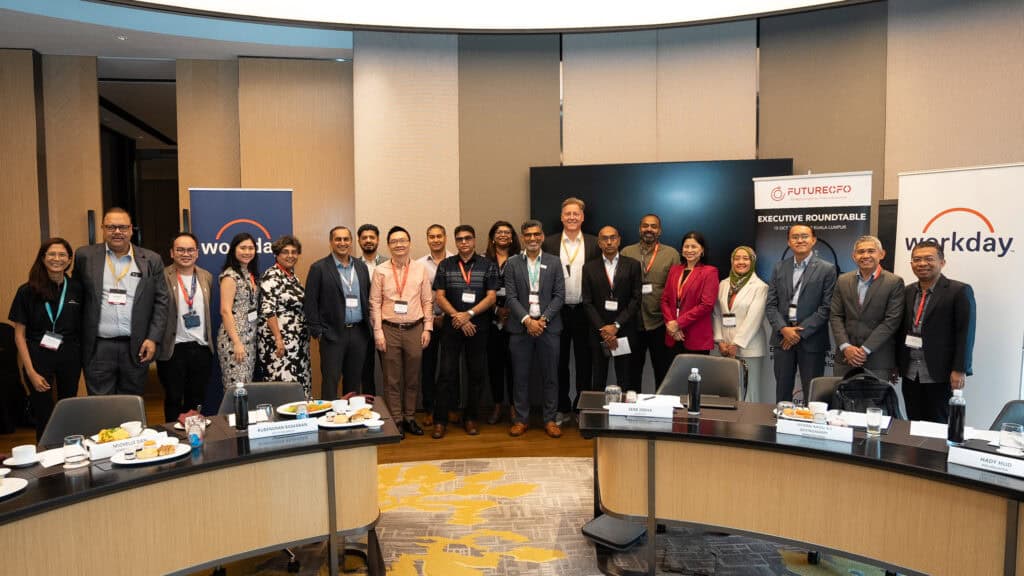
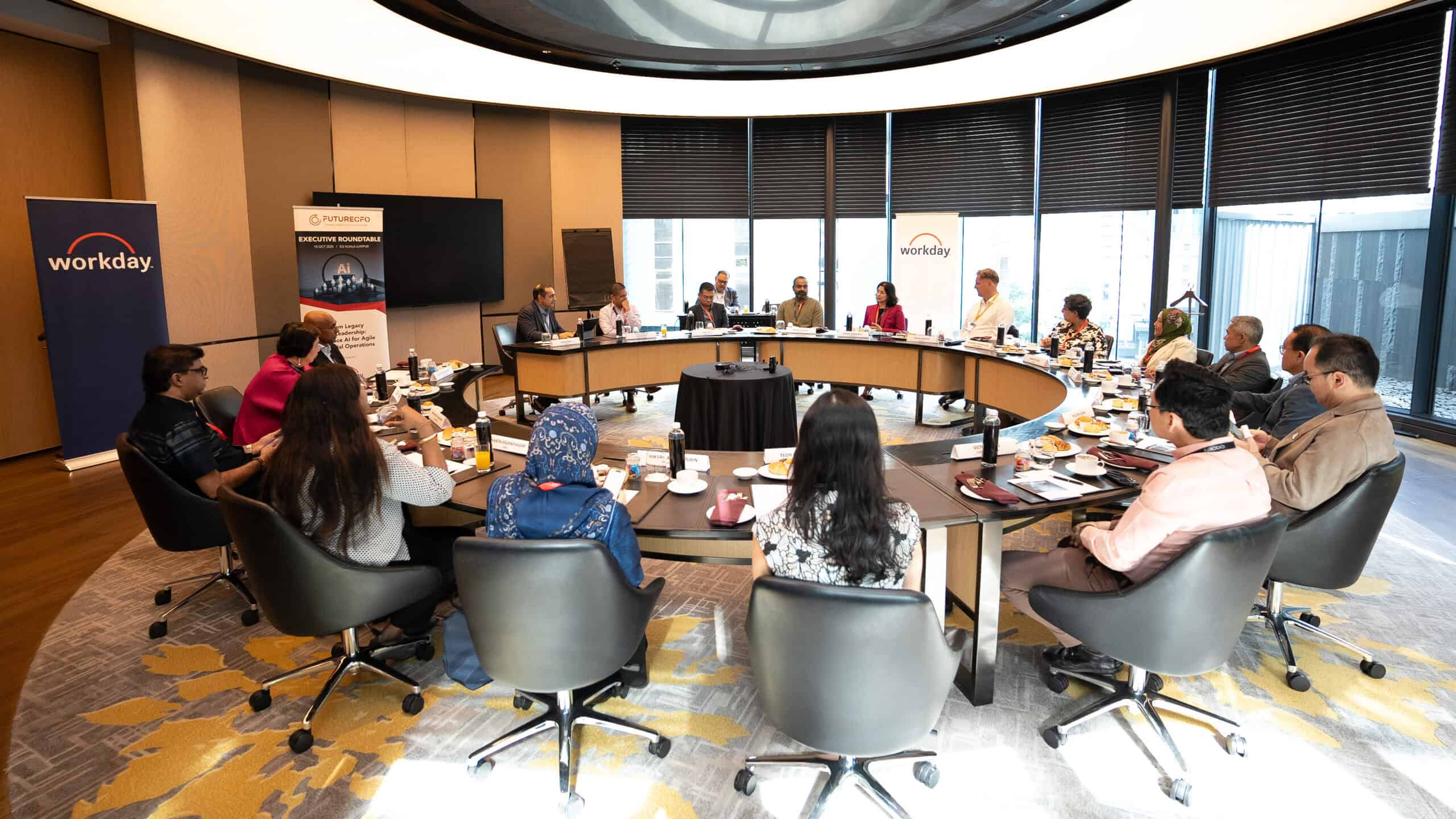
At a recent FutureCFO roundtable in Kuala Lumpur, organised in partnership with Workday, finance and operations leaders from banking, retail, insurance, oil and gas, and manufacturing gathered to tackle these challenges head-on. What emerged was a frank conversation about the realities of implementation, governance concerns, and the human dimensions of transformation.
The data foundation challenge

When Joanne Rodrigues, group chief financial officer at Affin Bank, describes her organisation’s AI priorities, she cuts straight to the operational reality: “We have so much data, and we know that humans have limited capability when it comes to processing large amounts of data. Today, AI provides us with the ability to query data for a deeper and more insightful analysis.
One delegate to the roundtable commented that the challenge of data consolidation operates at a global scale. Her organisation implemented Workday Adaptive Planning globally last year, replacing a customised system built in the 1990s.
“In our planning and budgeting activity, we standardise all of the grassroots planning criteria in each country, and the data entry and consolidation, and then the stewardship of it,” she explained. The move addressed a fundamental challenge: bringing standardisation and scalability to a multinational operation present in almost all countries.
For rapidly scaling businesses, one delegate stated that the challenge is even more acute in the retail sector, highlighting the complexity of hypergrowth: “We’ve grown really fast. What we’re finding is we’re playing catch-up with a lot of data. We get data and all of that, but from a process perspective, is how we necessarily leverage it.”
With eight different payment channels across multiple markets, he emphasised that “streamlining data or processes, and then that ability to integrate that within the broader organisation is going to be fundamental for us.”
From reporting to predictive intelligence
One delegate articulated the shift that defines modern finance: moving from retrospective reporting to forward-looking strategy. “In the permanent crisis world today that we are in, it’s very important that we monitor all those external disruptions,” she said. “AI to us is more on machine learning, on how to connect all that data externally [with] geopolitical, climate change [in mind]. Each one of these risks amplifies the other.”
Her organisation conducts scenario planning three times a year and forecasts monthly, with accuracy requirements of plus or minus 5%. “It is very important that we have some form of tool that can help us to make sure that we can do our scenario,” she noted, adding that AI’s value extends beyond analytics to compliance.
“AI can flag issues; you’ve got your first line of defence, then you’ve got the second line. You want to make sure that you’re able to flag the issues before the second line,” concluded the CFO from the insurance sector.
The pressure for faster, more granular forecasting is intensifying across industries. What was once quarterly forecasting has become monthly, and for some organisations, the horizon is shortening further still. The volume and velocity of data demand systems that can process, analyse, and surface insights at speeds human analysts simply cannot match.
The digital-first advantage
The CFO of a digital bank offered a contrasting perspective: Starting with Workday Finance and Adaptive Planning from inception, his lean team operates without the constraints of legacy systems. “We don’t have legacy to begin with, but we did start manually. So whatever manual that we have left will be automated,” he explained.
Yet even for a digital-first organisation, he identified talent retention as the primary challenge. “Everybody here will be looking at this company for talent,” he acknowledged, which was a concern shared across the room as traditional and digital-native organisations compete for the same pool of digitally-savvy finance professionals.
The governance imperative: Managing AI as employees

Niklas Ahnelöv, financial sales lead for Workday ASEAN, emphasised that data quality remains the foundation for any AI initiative.
“Bad data is the pitfall. We need good data to do good AI,” he stated. “Workday claims to have the cleanest data set in the world when it comes to people and money, because we’re an HR and finance system.”
But beyond data quality, Ahnelöv highlighted an emerging governance challenge that many organisations haven’t yet considered: managing AI agents themselves.
“We hear from our customers that if all these agents are coming from different angles, how are we going to control them? We have an ambition to be the system of record for the agents for your company, so you get the control and governance,” he explained.
This concept resonated strongly with participants. Rodrigues observed: “It would be as if they were another headcount.” Ahnelöv confirmed: “We think the agents deserve to be trained, they deserve to be onboarded, and they also deserve to be offboarded. We talk about responsible AI, and that’s a big part of it.”

Jeyanthi Rajanayagam, global transformation excellence manager at Shell, noted that her organisation already implements similar controls for existing automation: “We have a control room with approximately 200 robots governed by a small team. There are certain things that you run because it’s a control to make sure it doesn’t do something it’s not supposed to.”

Rajesh Mishra, country director for Malaysia and Indonesia at Workday, explained the practical governance: “How we manage our employees is how we manage the AI agents. The exact same security and governance framework that applies to your people also applies to the agents deployed as part of the solution.”
Navigating organisational resistance
Rajanayagam also provided insight into the organisational complexity of transformation. As a result, Shell created a global transformation team to drive integrated transformation opportunities across processes and businesses—focusing on end-to-end integration points, common opportunities and synergies, the right mindset and behaviours, and digital upskilling.
In addition, Shell established an internal Digital (DTA) team skilled in various digital tools, including Power Automate and OCR.
But technical capability isn’t the only barrier.
“People are quite nervous. If I automate something, I lose my job,” Rajanayagam noted. “Sometimes the person working on the ground knows they’re doing unnecessary work, but they are not brave enough to speak up. We need to help them understand their roles are going to evolve and become very interesting. That’s why mindset and behaviours, continuous upskilling, and helping them understand what future roles look like become critical.”
Her prescription: “You really have to think end-to-end, as you still need to evolve the way we operate the business—which is the key starting point for sustainable transformation.”

Jayaraj Naidu A/L Govindasamy, senior vice president at MNRB Holdings Berhad, confirmed resistance to change as a primary obstacle: “The main key challenge is people’s resistance to change, where they are actually comfortable with what they’re doing, with the legacy system. There is this resistance to change, plus this lack of confidence.”
His organisation has deployed targeted upskilling teams for automation training, which has improved group-level consolidation across subsidiaries and associate companies, smoothing audit processes in the bargain.
The ecosystem challenge
Another delegate raised a challenge that extends beyond organisational boundaries: ecosystem readiness. His organisation is embarking on an operational transformation, including the implementation of automated warehouse management systems and integrated procurement platforms.
But the challenge isn’t just internal. “We are working with suppliers from other parts of Asia, who may not be at the pace that you want to be.”
The data-sharing challenge extends across the entire supply chain, from suppliers to shipping lines to port operators. “Everybody is keeping their data to themselves… so it’s data that you need to track yourself. What I’m trying to see is how we can leverage AI so that everybody can benefit from having seamless operations,” he observed.
To which a fellow delegate agreed adding agreed: “We need to balance in terms of what will be the right investment that you are required to prioritise — whether your front end and also the back end, or you start with the back end and start to enhance your customer journey. Managing the expectation on our customer journey is key here.”
Turning AI disruption into transformation
From the roundtable discussion, it’s clear that Malaysian finance leaders aren’t waiting for perfect conditions or complete roadmaps.
For these Malaysian finance leaders, the journey from legacy to leadership is about building the organisational trust, data infrastructure, and change management capabilities that make AI adoption sustainable. As they navigate shifting regulatory frameworks, their collective learning and cross-industry collaboration are likely their most valuable assets.
From the discussion, it’s clear that they’re moving forward. But they’re doing so incrementally: learning from pilots, building internal capability, and grappling with governance frameworks that are still evolving.
By taking these steps, these finance leaders are determined to be architects of transformation, not casualties of disruption — quietly.