





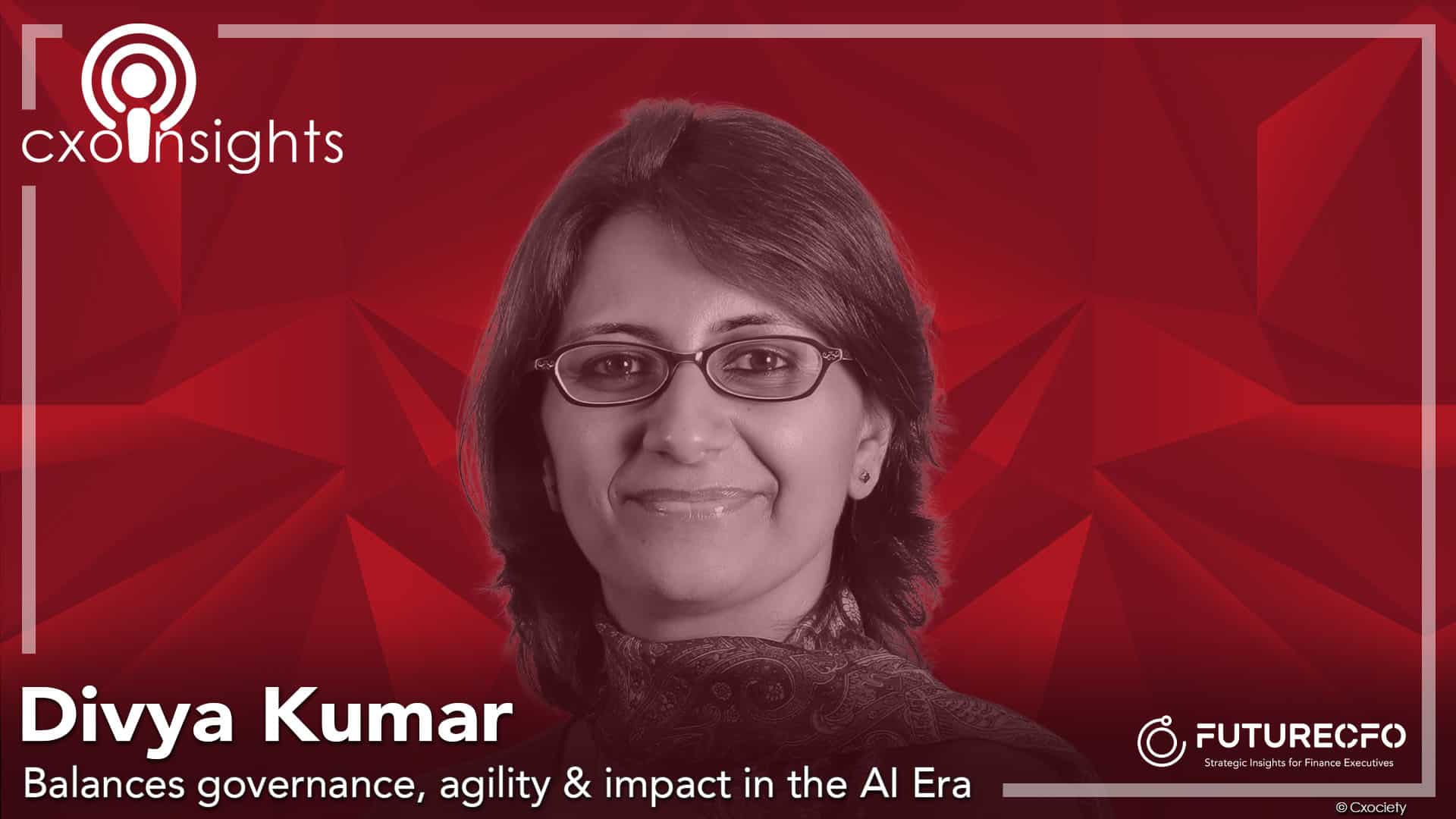
Over the last several years, successful CFOs have evolved from traditional financial stewards into strategic co-leaders who drive transformation with vision and discipline.
In the era of artificial intelligence, they are taking the next step in corporate leadership—integrating AI thoughtfully, championing agile practices, building data-driven cultures, and balancing innovation with robust governance to deliver measurable business impact.
Divya Kumar exemplifies this new breed of finance leader. With over two decades of experience scaling businesses and leading large-scale digital transformations across diverse industries and geographies, she has earned multiple CFO and executive leadership awards.
As a board member, keynote speaker, and author of the 2026 book CFO AI Compass, Kumar empowers finance leaders to co-lead their organization’s AI agenda while transforming the finance function itself.
In this PodChats for FutureCFO interview (recorded 27 March 2026), Kumar shares candid insights from her journey.
The four C’s driving leadership success
Kumar credits her rise to senior roles to four personal pillars she calls the “Four C’s”: curiosity, conviction, compassion, and character.

“Curiosity… learning about the market, learning about the business you’re in end-to-end can be a game changer,” she explains. Most of her leadership opportunities came from her strong understanding of the business and willingness to step outside her function.
For her, conviction is the belief that “anything is possible” – even when it makes her team sigh till they ultimately achieve it. Compassion, according to Kumar, builds trust: “When you genuinely care for people… they care back,” she declared.
She also believes that character rests on integrity and authenticity – never compromising on ethics and always leading as herself.
Global transformations: Building trust beyond borders
Leading global roles while based in India presented unique challenges. Kumar operated as an “outlier,” with teams across Europe, US, China and India, requiring extensive travel and family adjustments.
Yet she turned these into strengths: “If you build the right trust and you perform consistently, anything is possible.” Asked what for her was the biggest mindset shift: “Relationships are not about physical proximity but presence – being fully there when people need you.”
Two further shifts proved critical for Kumar during transformations: understanding connections and consequences across the organisation , and knowing “what not to change.” Protecting the core elements people care deeply about builds trust and turns employees into champions of change.
CFO AI Compass: A practical playbook for the four challenges of AI
Kumar wrote CFO AI Compass because boards were asking CFOs to “own AI outcomes” without a practical guide. She frames the challenge around four compass points: value, costs, risks, and people.
She has translated her real-life experiences into her book, such as:
- Value: Use a deliberate strategic and investment framework rather than random pilots.
- Costs: Understand AI economics and operating models early, as design choices have long-term consequences.
- Risks: Establish governance forums and responsible-use policies from day one.
- People: Communicate transparently to reduce anxiety and build ownership.
“The more transparent you are… the more you build that trust,” she notes.
Flexible budgeting that drives innovation
Kumar’s early articles on agile budgeting and analytics-driven FP&A were “ahead of their time.” Today, with rapid market changes, they have become essential.
She advocates reimagining budgeting as flexible capital allocation – reallocating during the year as and when needed based on strategic priorities and performance. In one organisation she led a cross-functional forum where innovation budgets were deliberately flexible. Teams made joint decisions, tracked outcomes, and exited underperforming investments quickly.
This preserved governance and accountability while enabling innovation to flourish. CFOs must “unlearn” excessive control that stifles flexibility: “We need to support innovation and agility while retaining control … one is not apart from the other.”
Today, advancements in AI have made agile budgeting and real-time analytics possible at scale.
Recent industry data echoes this. Deloitte’s 2026 Finance Trends research shows 63% of finance departments actively using AI, with real-time analytics enabling faster decisions.
Governance and innovation: Two sides of the same coin
“Innovation inherently brings risks,” Kumar states. “When you want to contain that risk… you have to have governance around it.”
In multinationals, global teams set the frames: with strategy, success metrics, policies on ethics and responsible use, and centres of excellence. They also co-create standard use cases with local teams.
An enterprise portal tracking all initiatives proved transformative: it encouraged local innovation, shared successes/failures, reduced duplication, and created accountability.
Cross-border operations require extra vigilance on evolving regulations. Global oversight ensures compliance without slowing momentum.
PwC’s 2026 CFO agenda highlights exactly this: “scaling governed AI to fuel growth and strengthen risk management.”
Secure a seat at the AI table
Kumar’s experience connecting strategy, finance, operations, digital and analytics gives her an edge in global and country boards.
She advises finance leaders: invest in your own learning. You don’t need to code, but you must understand how AI works at a common-sense level – data inputs, decision logic, limitations – plus key terminology. Her book defines 50 core concepts precisely for this reason.
When CFOs lead AI accountability, results soar. A 2026 Fortune analysis found that when CFOs own AI value delivery, 76% of companies achieve “great value” – far higher than when other roles lead.
Fostering a culture of bold innovation
Kumar stresses balancing humility with inspiration. “We need humility to accept that we do not know everything.” She openly says, “I do not understand this topic. Can you explain it to me?”
Paired with curiosity and courage, this counters the fear of the unknown that fuels AI anxiety. As knowledge grows, fear recedes and informed risk-taking rises.
She began her AI journey in 2015 with machine-learning courses at Capgemini and continues upskilling today. Culture matters: when leaders model vulnerability, teams feel safe to learn and even to fail.
Empowering the next generation of women leaders
To emerging women leaders, Kumar offers one core lesson: “Believe in yourself and believe that everything is possible.”
Her parents instilled this from childhood. She surrounds herself with positive, encouraging people and stays authentic. “There are many things in life… which hold us back, but what propels us will be only what we do about it.”
Reflections on International Women’s Day
Kumar hopes one day International Women’s Day will no longer be needed because equality is complete. She has experienced both discrimination and strong male allyship. Progress is different by country, culture, and company – but real change begins at home: “It starts with parents and how they bring up children… that they are not different.”
Divya Kumar’s journey shows that the most effective CFOs in the AI era combine technical fluency, governance discipline, and deeply human leadership. Her practical wisdom – and the frameworks in CFO AI Compass – offer a clear compass for finance leaders across Asia and beyond who want to turn AI hype into measurable, responsible impact.