





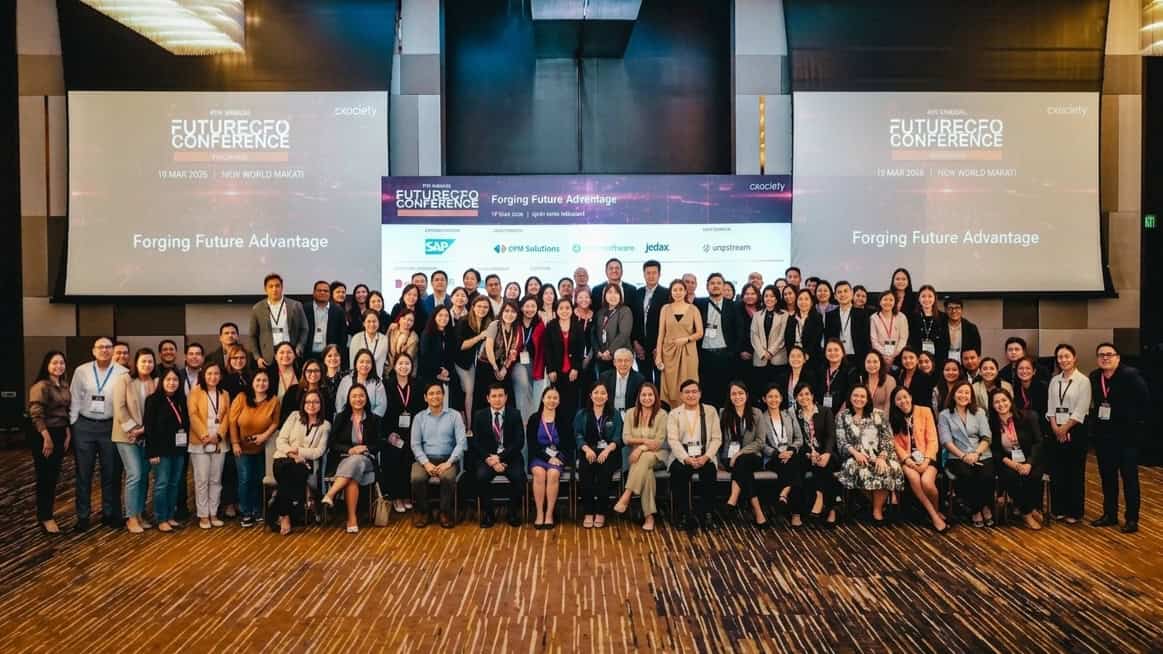
The 6th Annual FutureCFO Philippines Conference 2026, themed “Forging Future Advantage,” concluded successfully with more than 250 senior finance professionals from the country’s leading organisations in attendance.
Held amid the International Monetary Fund’s projection of 5.4% economic growth for the Philippines in 2026—tempered by global trade uncertainties, geopolitical tensions, climate impacts, and the promise of structural reforms—the event served as a pivotal platform for finance leaders to explore how artificial intelligence and strategic foresight can transform challenges into competitive strengths.
Discussions centred on merging technological advancements with prudent financial strategy to unlock growth, efficiency, and resilience. A total of 87 questions were submitted by delegates throughout the day.
These reflect real-time audience priorities and align closely with the conference programme. Questions have been grouped below by commonality of interest, with approximate counts and representative examples.
Economic pressures and the evolving role of finance
The programme opened by framing the macroeconomic landscape, noting that accelerated adoption of artificial intelligence could add substantial value to gross domestic product by 2030, while enhancements in cross-border payments position the Philippines as a regional commerce hub.
Finance functions, once seen primarily as brakes on operations, are now expected to act as engines of strategy and innovation. Throughout the day, speakers and panellists emphasised agility, human judgement paired with AI empowerment, and the need to balance opportunity with risk in a volatile environment.
Scaling growth and resilience in uncertain times
A lively fireside chat examined how finance leaders can drive enterprise expansion while safeguarding organisational resilience. Participants discussed transcending traditional roles to allocate capital effectively, navigate new tax regimes and regulatory shifts, and prioritise investments in innovation.
An audience poll revealed that 66% of delegates identified geopolitical and trade tensions as the top risk to business resilience in 2026, followed by economic slowdown from corruption scandals at 18%, regulatory or tax changes at 9%, and technological disruptions (such as cyber or AI scams) at 8%.
Panellists explored the use of AI analytics to identify growth opportunities within a modest GDP trajectory, contingency planning for tariffs and climate shocks, and frameworks for directing capital toward sustainable projects without compromising returns.
Transforming finance from control to strategic driver
A keynote address traced the evolution of the finance function, advocating for strengthened technology, processes, and people as the foundation for future advantage. In an era of agentic AI, the session stressed maintaining human oversight while trusting automated systems and identified core skills—such as strategic foresight and data interpretation—essential for relevance.
Delegates engaged with questions on trust in machines and workforce development, setting a reflective tone for subsequent sessions.
Navigating complex regulatory landscapes
A dedicated panel tackled the expanding compliance remit, encompassing fintech, artificial intelligence governance, digital assets, and cross-border trade rules. Finance leaders shared strategies for treating compliance as a strategic investment rather than a cost, achieving balance between innovation and oversight, and fostering collaboration across legal, IT, and operational teams.
An audience poll indicated that 72% viewed AI governance and ethics as requiring the most immediate attention from finance teams, with enhanced ESG disclosure standards at 16% and cross-border data privacy at 12%.
Panellists highlighted proactive compliance approaches that generate business value, the importance of future-proof frameworks, and pitfalls in managing divergent ASEAN regulations—offering actionable insights for organisations expanding regionally.
AI: From Hype to integrated business partner
Morning sessions deepened the focus on artificial intelligence integration. A keynote illustrated the shift toward AI as a reliable digital collaborator, moving beyond experimentation to deliver tangible outcomes.
This was followed by a panel that referenced global trends showing widespread adoption of AI for automation, planning, and risk management. A poll revealed that 40% of delegates expected AI to fully own accounts payable or receivable matching and reconciliation by the end of 2026, followed by AI data extraction and automated data entry at 20%. Smaller shares anticipated cash-flow forecasting (11%), monthly close and consolidation (12%), and variance analysis and commentary (12%). Only 5% indicated the lack of formal plans around AI.
Discussions centred on prioritising high-value use cases, de-risking initiatives amid high failure rates, measuring improvements in decision quality rather than mere time savings, and structuring governance models—whether centralised centres of excellence or embedded hybrid teams. Panellists addressed the challenges of scaling pilots, managing rising cloud costs, and upskilling accountants through targeted training programmes.

“AI is an accelerator. If we apply AI to a broken process with poor data, it will not create better results. It will only accelerate bad ones. CFOs should map the workflow end to end, remove process gaps, strengthen controls, and clean the data before scaling AI,” said Mikhail Salinas, director, controller, site lead, Global Business Services, at Analog Devices.
Real-time financial management amid volatility
Post-lunch, a keynote demonstrated how artificial intelligence enables continuous planning, agile scenario modelling, and predictive analytics to convert economic unpredictability into advantage. Emphasis was placed on automating routine tasks, optimising costs in real time, and embedding low-code solutions into core finance operations.
This forward-looking perspective aligned closely with the conference theme, equipping leaders to respond dynamically to currency fluctuations and operational pressures.
Tackling technology overload and integration hurdles
A subsequent panel confronted the pitfalls of fragmented tech stacks, including data silos, workflow inconsistencies, and decision fatigue.
Delegates overwhelmingly identified inefficient processes and manual workarounds as the most significant negative impact (62%), followed by inconsistent or untrustworthy data (34%). High maintenance and licensing costs attracted only 4% of responses. Surprisingly delegates did not seem concerned over issues like low team morale and its impact on productivity.
Finance professionals explored rationalisation techniques, integration-first strategies, and criteria for deciding between building capabilities, purchasing point solutions, or leveraging existing enterprise systems.
Advice centred on conducting regular audits, managing tensions between best-of-breed preferences and standardisation, and future-proofing ecosystems against emerging disruptions—culminating in practical recommendations for peers overwhelmed by software subscriptions.
Talent transformation for an ai-enabled finance function
Another panel addressed the evolving talent landscape, citing expectations that digital finance roles will comprise nearly half of teams by 2027.
During the session, data analytics and visualisation emerged as the highest-priority hybrid skill for development (37%), ahead of process automation at 29%, business partnering and strategic communication at 24%, and AI literacy with prompt engineering at 11%.
Discussions examined hybrid role designs, strategies for spotting reskilling potential among existing staff, attracting digital talent beyond salary incentives, and embedding AI literacy across all finance professionals.
Panellists outlined future-ready organisational charts, new positions created to bridge skills gaps, and approaches to maintaining morale during transformation.
Economic outlook and strategic priorities
The closing keynote analysed key macro indicators—public trust dynamics, export trends, inflation, interest rates, and currency movements—offering practical adjustments for finance leaders to maintain agility through 2027.
The day concluded with closing remarks and a word-cloud poll on delegates’ top strategic priorities. “Growth” and “Sustainability” dominated the mindsets of executives attending the conference. This was closely followed by “AI”, “Resilience”, “AI readiness”, “AI literacy”, “automation”, and “governance”, reflecting a clear focus on value creation and futureproofing.
The conference underscored that Philippine finance leaders stand ready to leverage artificial intelligence, regulatory foresight, and talent development to forge lasting advantage. By turning volatility into opportunity and embedding technology at the heart of strategy, attendees left equipped to navigate 2026’s complexities with confidence and innovation.