





It’s not hype. Enterprises are adopting a data-driven business model. Gut-feel decision-making has given way to data-based decision-making. This is affirmed by a 2019 study conducted by the IBM Institute of Business Value (IBV) in cooperation with Oxford Economics.
The study, Build Your Trust Advantage, revealed that 80% of surveyed leaders say they and their C-Suite colleagues have deep trust in data to perfect the quality and speed of the decisions they make. In addition, 65% of C-suite executives believe that automation of decision-making processes will increase in their business landscape over the next 2-3 years.
For finance teams adopting a data-driven mindset as part of their digital transformation initiative challenges remain.
Data-driven finance
The 2018 IBM Global C-suite Study of CFOs noted that two-thirds of CFOs surveyed confirm that their agenda includes taking an active role in developing strategy, driving growth, reducing costs, managing risks and providing insights.
Chief among these challenges – and opportunities centres around data – its creation, use and lifecycle management (see Figure 1).
Figure 1: CFOs worry that their teams aren’t ready to weather the disruption
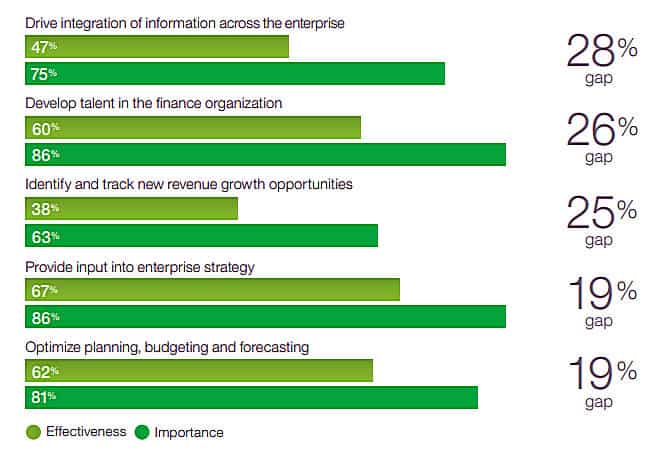
Source: Insights from the Global C-suite Study – The CFO Perspective 2016, IBM IBV
Finance needs to engage and weigh in much faster on emerging opportunities. Meaningful business partnerships and alignment shape this new paradigm, with a degree of responsiveness enabled by improved curation and analysis of integrated enterprise and environmental data.
In commenting on the importance of intelligent workflow and its impact on the finance function’s transformation journey, Neeraj Manik, managing partner, Cognitive Process Re-engineering and Services, IBM Asia-Pacific noted that intelligent automation completely reimagines how work gets done.
“This includes systems of engagement are built and used on top of the enterprise systems of records to deliver a completely different experience for its users, employees, partners, vendors and customers,” he added.
Challenges for finance in 2020
It’s the New Year – 2020. Finance transformation is no longer an option. It should be a given – at least for organisations that are on track towards transforming themselves into digital-native enterprises.
Unfortunately talking transformation is easy. Making it happen – that’s the hard part. Gartner’s Alexander Bant, managing VP, finance advisory, estimates that as much as 70% of finance transformation initiatives fail to deliver the forecast benefits to the business. These also fail to deliver on the cost objectives set out for the transformation.
He revealed, however, that despite these failings 85% of finance teams are undergoing finance transformation.
Dan Garvey, director, finance advisory at Gartner says efficiency drives many of these transformation initiatives. But even this simple desire for efficiency is riddled with challenges.
IBM’s Manik lists these challenges as including the proliferation of IT systems that draw data sources from multiple sources, multiple versions of what it craves for – the truth.
He attributes this to decades of acquisitions, mergers, divestitures that combine with changes in the business model, as well as disparate workflows. He added that to drive the transactions there are a large set of manual repetitive processes that are in place in almost every enterprise.
“The challenge organization are facing today in reinventing finance is how do they really elevate the function to be a trusted adviser for the business, manage risk, manage the changes in regulatory environment, manage the new emerging business models in a seamless manner as a trusted advisor to the business leaders versus being an aggregator of data or spending enormous time doing transaction processing,” concluded Manik.